
Organizations and teams constantly deal with endless problems during their work. Maybe it’s due to some natural, instinctual way humans react to problems, but the typical response I see teams take is to try to fix them with what I call “One-time efforts.”
While appealing, one-time efforts are not well-suited to the complex problems teams face. These approaches often fail to create lasting change and can waste people’s time.
I encourage a different approach with my teams, and that’s the unglamorous, demanding, and slow work of continuous improvement. The goal isn’t to prevent problems, but for teams to develop the capability to deal with those problems themselves, even if they resolve them more slowly through incremental progress.
The Allure of the Quick Fix
It’s understandable why one-time efforts are so appealing. They promise to resolve a visible and tangible problem immediately and provide a simple, causal order of events: You have a problem, but if you do this thing, that problem will go away.
Examples include:
- Running a workshop to install a new mindset into a group of people
- Implementing a new practice or framework to improve a particular outcome
- Applying an intervention to correct an undesirable behaviour in a person or team
However, these approaches often focus on whatever symptom is causing the most visible fire or creating the most pain rather than on the real root causes. Once the one-time efforts are over and the workshop ends, there’s usually nothing preventing things from reverting back to the status quo. One-time efforts often work ahead of what an organization’s systems can support.
One-time efforts also tend to align with people’s biases or beliefs. For example, suppose an organization faces challenges related to delayed projects. In that case, without even considering the underlying causes, an Agile Coach might respond by running a workshop on the “Agile Mindset,” whereas a Project Manager in the same scenario might focus on completing a RACI or better planning.

The Alternative: The Consistent Practice of Continuous Improvement
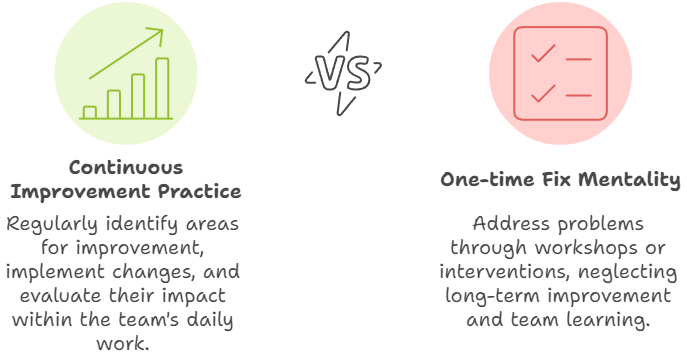
Rather than relying on workshops or training to address a team’s issue, the focus should be to develop a continuous improvement practice. This involves regularly identifying areas for improvement, implementing changes, and evaluating their impact, all within the context of your team’s daily work.
To move away from the one-time fix mentality, resist the urge to address problems through workshops or interventions. First, take a moment and reflect on what’s happening, and ask yourself:
- How could we address this issue as part of our regular work?
- Where is this problem coming from?
- What other approaches could we take if we couldn’t run a workshop?
Instead of relying on one-time efforts, focus on establishing a consistent improvement practice. This approach not only better equips teams to handle the problems they encounter but also emphasizes team learning and growth.
If, at some point, after they’ve developed a continuous improvement practice, teams need some extra help or need to resolve an urgent issue quickly, they can do so, but it’s not effective if the only way a team has to deal with their problems is through one-time efforts.
Improvement requires constant effort. Just as you can’t become physically fit from a single workout, teams can’t achieve lasting improvement from a one-time effort.
The Challenges of Continuous Improvement
Admittedly, developing a continuous improvement habit is more challenging than planning and running a one-time effort like a workshop. It requires:
- Consistency and persistence
- Acceptance that results may not be immediate
- Recognition that there’s rarely a simple, one-size-fits-all solution to complex problems
Learning is an integral part of knowledge work. To improve, a team needs to continuously improve its understanding of its domain, its ability to learn, and its ability to deal with challenges.
While the benefits of continuous improvement may take time to materialize, they are more substantial and sustainable in the long run.
Conclusion
While one-time efforts might seem straightforward and intuitive, they fail to create lasting change for several reasons:
- They often address surface-level symptoms rather than root causes.
- Without ongoing support, things revert to the status quo.
- Big one-time efforts can create a false sense of accomplishment as busyness and activity are celebrated rather than results.
- When they fail to produce the desired effect, one-time efforts waste people’s time, making it harder to address the real issues later.
If your team doesn’t already have a continuous improvement habit, start now. The most crucial part of getting started is consistency. Start with volume.
Focus on consistency and thoughtfulness in your continuous improvement efforts, and you’ll see quality improve and results emerge organically.
 Flow Focused
Leave a comment