
When someone asks me to define Agile, I often say it’s about moving forward even when you don’t have all the answers and instead embracing uncertainty and learning as you go. However, I’ve seen in the large organizations I’ve worked with struggle with this concept. Even if organizations want to be agile, they’re deeply programmed to crave predictability and reward certainty.
In large organizations, management might promote Agile but still want some assurances. They like to see things like:
- A fixed set of team practices, roles, and ceremonies that every team will follow
- Standardized Kanban board designs and processes
- Agile teams working within waterfall project structures
Whether it’s about what the team does or how, all these expectations share a common belief: that knowing the answers upfront is possible. And the first people to provide those answers are the experts on agile, the Agile Coaches.
When Agile Coaches give these answers to management, it sets any agile journey or transformation off on the wrong foot by immediately removing teams from the discussion and stripping them of any decision-making power over how they work.
Instead of on trying to provide answers to satisfy that need for certainty, coaches should focus on building the team and organizational agility needed to deal with uncertainty.
The Role of an Agile Coach
Agile coaches should not be the ones with all the answers, distributing instructions to teams or telling management how teams will work. It’s tempting to play the expert, but with complex problems, knowing the solution ahead of time is impossible.
Even if an Agile Coach knew the correct answer, providing those answers might make them look good, but it would create a long-term dependency. This is a classic case of ‘shifting the burden’, a term from systems thinking. Shifting the burden happens when the symptom is treated, but the fundamental solution is not addressed. In the context of Agile coaching, it means providing solutions instead of empowering teams to find their own answers, which can hinder their growth and maturity.
A real team should be able to do their work and solve their problems without relying on external help. So, what’s the alternative?
Adding Real, Lasting Value
Coaches don’t directly affect outcomes; they focus on the teams. Instead of telling teams what to do or making decisions for them, there are a few ways Agile Coaches help a team achieve its goals. Coaches do this by:
- Creating clarity and shared understanding around challenges
- Emphasizing the process of discovering answers through experimentation and feedback.
- Focusing on team dynamics
The coach’s job isn’t to do the team’s work but to help them develop their ability to tackle challenges. Coaches pay attention to how things are working and identify opportunities to help the team grow and improve. They nudge the team closer to becoming the team they want to be. This also means that for coaching to work, teams need to accept coaching and be willing, engaged, and care about their work.
So, what can Agile Coaches do to provide real, lasting value? Here are some key areas:
- Educate:
- Train team members, managers and leaders on Agile principles and practices.
- Share knowledge and experience to enhance the team’s understanding of Agile.
- Improve team facilitation, collaboration, and communication:
- Help the team improve how they facilitate team meetings, retrospectives, and problem-solving sessions.
- Help the team collaborate with stakeholders to resolve organizational impediments.
- Help the team communicate progress and outcomes to stakeholders.
- Install feedback loops:
- Implement feedback loops for the team to reflect on their workflows and practices
- Implement feedback loops to identify and remove impediments and blockers.
- Implement feedback loops for the team to assess their progress towards their goals and identify areas for improvement.
- Highlight and note:
- Listen and ask questions to raise awareness on important issues.
- Provide expert Agile guidance:
- Advise on implementing Agile tools and practices.
- Collaborate with the team:
- Collaborate closely with the team on their work and with their improvement efforts
- Mentor individuals on their Agile journey.
- Role model:
- Embody Agile values and principles
- Foster a culture of transparency, trust, and continuous improvement.
- Encourage active participation, collaboration, and open communication
- Help to create a conducive environment for Agile to thrive
- Support continuous learning and professional development
- Find opportunities for the team to take ownership and make decisions
- Encourage the team to self-organize and collaborate effectively

The Goal: Improving Team Maturity
Agile coaches play a significant role in this journey, inspiring and motivating teams to strive for continuous improvement and innovation.
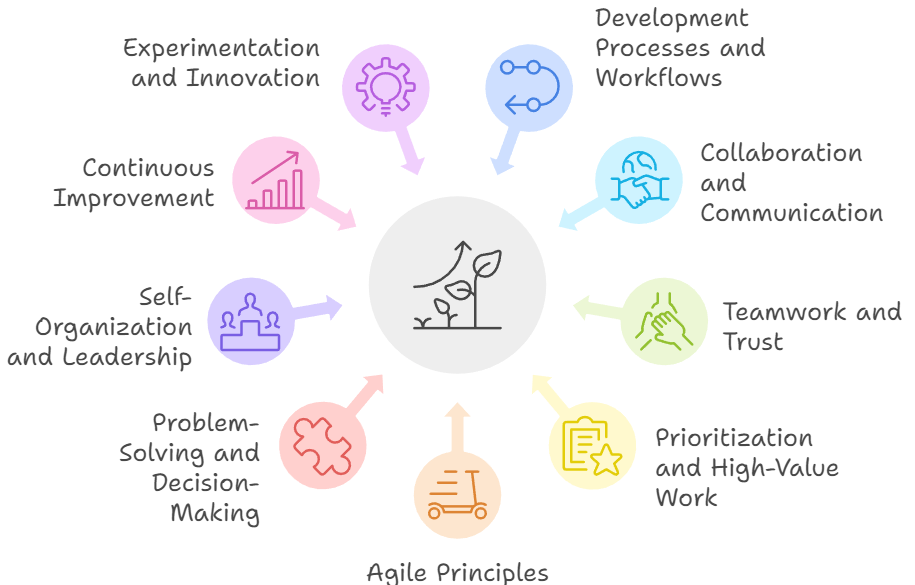
Coaching is the activity of long-term team development. Coaches still care about outcomes, but can’t directly affect them. I like to think of coaching as working towards outcomes indirectly by adjusting a set of levers.
Everything an Agile Coach does aims to improve the team’s maturity via these levers, which include:
- Development processes and workflows
- Collaboration and communication
- Teamwork and trust
- Prioritization and focusing on high-value work
- Understanding and applying Agile principles
- Problem-solving and decision-making
- Self-organization and leadership
- Continuous improvement
- Experimentation, learning, and innovation
Coaching Outcomes
When Agile Coaches perform their role effectively, teams improve, and when teams improve, we can expect two sets of outcomes: Team outcomes and business outcomes.
- Team outcomes:
- Streamlined processes, reduced waste and fewer bottlenecks
- Improved predictability
- Improved productivity and efficiency
- Enhanced problem-solving skills
- Increased employee engagement and satisfaction
- Business outcomes:
- Faster delivery of high-quality products
- Better alignment between team efforts and business goals
- Increased adaptability to changing requirements
- Improved customer satisfaction
- More transparency
- Reduced project risk
Embrace Uncertainty
In uncertain environments where teams are always doing something for the first time, there’s no clear answer you can know ahead of time. If we could determine the perfect team structure, process, or requirements at the outset, we wouldn’t need Agile.
Solutions can only be discovered through action, which is core to how Agile teams work. Every project, improvement, or user story should be approached experimentally as a bet, hypothesis, and experiment to test.
Conclusion
Agile coaches should stop thinking their expertise gives them the ability to tell organizations and teams how they should work. It’s contrary to the very idea of Agile. Instead, they can make their biggest impact by creating a bridge between two opposing ideas:
- People want certainty
- We work in uncertain environments where things are constantly changing
This can be achieved through team and organizational agility—the ability to respond to change, learn quickly, adjust rapidly, and constantly satisfy users’ needs.
Successful Agile Coaches empower teams to find their way forward in a complex and constantly changing landscape. By helping organizations and teams embrace this paradox, Agile Coaches can foster environments where true agility can thrive.
 Flow Focused
Leave a comment