
When organizations strive for agility, they often fall into the trap of adopting numerous agile terms and practices associated with popular frameworks like Scrum. While this approach generates a lot of internal activity, it often fails to translate into actual agility. In my experience, labelling and promoting certain practices as ‘Agile’ or ‘Important’ can be counterproductive. It leads to adopting inappropriate practices and hinders progress towards of genuine agility in the long run.
I’ve observed that the more an organization uses the word “Agile” or Scrum-specific terms in their daily language, the less likely it is to embody true agility and the more likely teams are to follow practices on autopilot.
This realization has led me to stop describing practices and behaviours as “Agile” or “Not Agile.” Instead, I’ve started to be more descriptive when talking to people about agile practices, sharing with teams the intent of practices and the principles behind them.
An even more effective approach is to drop the focus on practices altogether and instead help teams create clarity about their challenges and the outcomes they hope to achieve so they can develop their own original approach.
The Danger of Autopilot
When management or Agile Coaches push agile practices onto teams, they lose their original meaning and become fixed steps in a process. Teams slip into autopilot mode and treat the practices as a checklist activity. Teams start talking about what they “have to do” rather than considering whether it’s the right thing to do.
Examples of autopilot mode are when teams treat user stories as technical requirements or developer tasks or when teams use sprints only to prove they’re making progress to management. In both cases, the true intent behind these practices is lost. As Allen Holub pointed out, “The term ‘user story’ has become not just meaningless but counterproductive.”
In my experience, when managers and Agile Coaches use their authority to promote practices as intrinsically valuable, it’s a net negative. The wrong practices spread, whether they add any value or not. These practices spread quickly, become embedded, and become much more difficult to change in the future. Finally, teams miss out on any sort of learning and growth opportunities they might have had.
Breaking Free from the Practice Trap
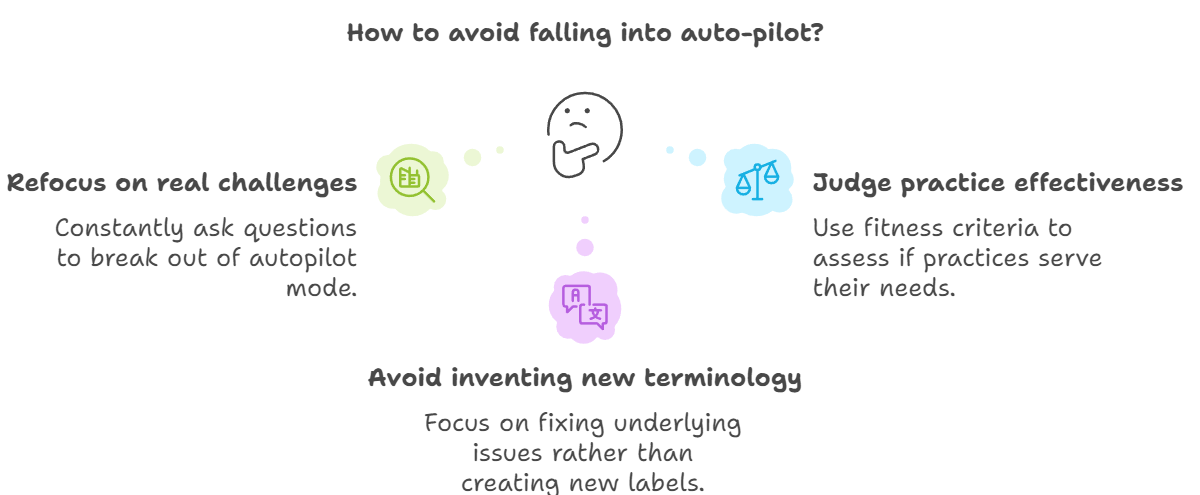
To avoid falling into the trap of teams executing practices on auto-pilot, constantly refocus your team’s attention on the real challenges they face:
- What problem are we solving?
- Why is solving this problem important?
- What do we want to have happen?
- What should we do next?
By regularly asking these questions, teams can break out of autopilot mode and instead start thinking critically about their process and goals.
Judging Practice Effectiveness
Rather than proclaiming that any practice is universally valuable, teams should judge for themselves the effectiveness of practices based on a set of fitness criteria.
For example, a team could use the following set of questions to judge the fitness of a practice:
- Whose needs does this practice serve?
- Does it add or reduce overhead?
- Are there other ways to solve the same problem?
- Is this addressing a real problem or a hypothetical one?
Real agile teams are flexible and shouldn’t unquestioningly adopt or stick with practices that aren’t serving their needs. Teams should adopt practices that prove useful and evolve their process based on experimentation, feedback, and experience. They improve by continuously reflecting on how they work, thinking about the challenges they face, and experimenting, resulting in something unique to them.
The Danger of Inventing New Terminology
Another pitfall organizations can fall into is when they feel the need to invent new terms, which artificially inflates their journey to being more agile. Creating a new label for ‘agile teams’ (to differentiate them from the not-agile ones) or creating new variations on concepts like ‘MVP’ is unnecessary and a surface-level treatment of the problems these organizations face.
This approach of creating new terminology artificially inflates the perceived agility of the organization, and has the same impact of increasing movement and activity but ignores the actual problems. Be cautious of such tactics and focus on the real issues at hand.
Instead of creating a new label to give to “agile” teams to distinguish them from not-agile ones, wouldn’t it make more sense to fix the issues that make them not-agile in the first place?
In all cases I’ve seen new terminology invented to support an agile transformation, everybody got into the habit of using the terms, but only a small few ever really understood what the terms represented.
Recommendations for Fostering Real Agility
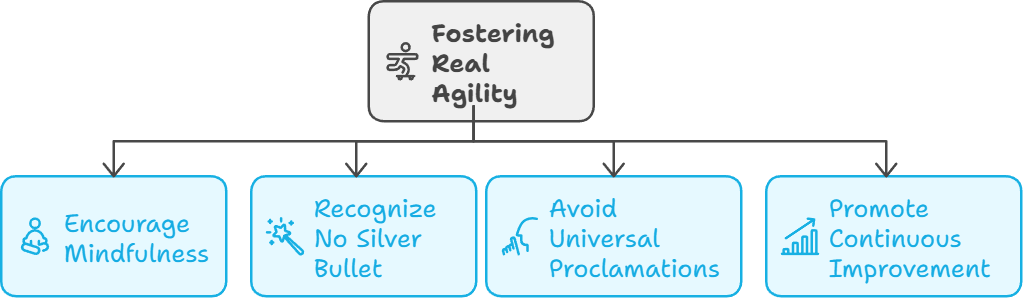
John Shook’s Change Model says we change our behaviour to change our thinking. Rather than take that lesson to mean starting an agile transformation journey with an over-emphasis on agile practices, here are four small steps to take instead:
1. Encourage Mindfulness: Teams should always be mindful of the problems they’re trying to solve, why they are doing things, and how they can improve.
2. Recognize There’s No Silver Bullet: No single practice, team structure, or framework will make you agile. True agility comes from continuously focusing on customers’ needs and improving how you work to meet those needs.
3. Avoid Universal Proclamations: If you’re in an Agile Coach role, resist the urge to promote or discourage practices by labelling them universally good or bad. Instead:
- Help teams understand the intent of particular practices
- Explain the trade-offs involved
- Share alternative practices to consider
- Help teams articulate their problems and desired outcomes and develop their own solutions.
4. Promote Continuous Improvement: Engaging teams in ongoing reflection and improvement might be the one universally ‘good’ practice worth promoting. This commitment to continuous improvement is vital to fostering genuine agility and should be a top priority for all involved in agile transformations.
Conclusion
Agility isn’t achieved by focusing on practices or being rigid. Agility is the outcome of continuous learning, adaptation, and improvement. By rejecting the practices pushed by agile platitudes and focusing on solving real problems, teams can develop the flexibility and responsiveness that define genuine agility.
 Flow Focused
Leave a comment